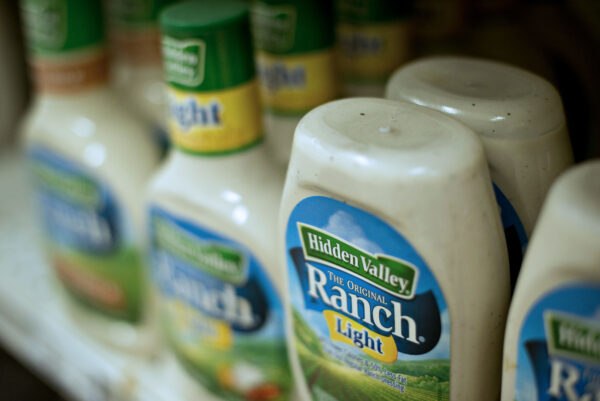
Ranch-style dressing has apparently become popular enough with foreigners visiting the US that the Transportation Safety Administration (TSA) was forced to issue a PSA reminding them to stop bringing home bottles in their carry-ons.
“If you’re visiting for a very large sporting event & you happen to discover RANCH while you’re here… pls pack it in your CHECKED BAG on the way home,” the TSA wrote on Instagram earlier this month. “Thank you.”
Le Creuset now makes products for food on the go
The agency also joked (maybe) that departing visitors were “chugging” ranch when they were told to discard it.
“Days since the last airport ranch incident: 0,” the TSA added.
Americans, meanwhile, have been raving about ranch since shortly after its was popularized among — wait for it — hungry Alaskan plumbers.
Where was ranch dressing invented?
As the story goes, Steven Henson, the Nebraska native who created ranch dressing, invented the now-ubiquitous condiment after moving to Anchorage in 1949 and taking a job as a plumbing contractor in the Alaskan bush, according to a biography of Henson published in the Santa Barbara Independent. Henson concocted the recipe for what would later be dubbed “ranch” dressing somewhat out of necessity, the outlet reported, after taking on a secondary role in the kitchen while “trying to keep his hungry work crews happy.”
“It’s tough to feed men up in those bush jobs,” Henson once remarked in an interview with the Los Angeles Times, according to an archived article cited by Tedium. “If they don’t like something, they’re as likely to throw it at the cook as they are to walk out cursing. I had to come up with something to keep them happy,” he added, noting that it was during this time in the then-Alaska Territory that ranch dressing “came into being.”
Within just a few years, Henson had reportedly saved up enough money to retire. He and his wife moved to California in the mid-1950s, where they purchased 120 acres of land in the mountains near Santa Barbara (then-called Sweetwater Ranch, according to the Independent) and rechristened it as “Hidden Valley Ranch.”
“I wouldn’t call it a ranch, in reality,” remembered Alan Barker, a former employee at Hidden Valley Ranch who spoke with CBS Sunday Morning in 2021. “There were no animals, there were no crops. It was a motel in the mountains.”
By most accounts, Henson’s “ranch” didn’t attract too many guests. But the ones who did visit reportedly raved about the dressing at the on-site restaurant, with some “asking Steve for jars of his ranch dressing to enjoy at home with their friends and family,” according to the Hidden Valley Ranch dressing brand’s own record.
“From my memory, it was buttermilk, Miracle Whip, some spices and I think some chopped-up shallots — and then, the ingredient that was kept secret: pure MSG,” Barker, the former Hidden Valley Ranch-hand, told CBS News. (Barker also claimed in an earlier interview with the L.A. Times that the dressing called for “buttermilk and mayonnaise,” making no mention of Miracle Whip specifically. Henson, meanwhile, had long before admitted to using MSG in the ranch packets he would eventually sell.)
Henson soon started focusing more on the dressing than the ranch. He provided it to a local restaurant (the still-operating Cold Spring Tavern) and began producing dry seasoning packets to sell off-site, and later through the mail. Customers needed only to mix the contents of the packets with buttermilk and mayonnaise to have their own Hidden Valley Ranch dressing at home.
Henson’s business took off by the late ‘60s and early ‘70s, after which the Clorox Company offered Henson $8 million for the whole operation, the Santa Barbara Independent reported. In the ‘80s, Clorox ultimately developed a shelf-stable bottled version of Hidden Valley Ranch — rather than just a dry mix — that could be shipped to retail outlets.
Check out the deals of the day on Amazon’s Kitchen Outlet
Henson himself sold the physical Hidden Valley Ranch in 1973, but maintained properties in Palm Springs, California, and Sparks, Nevada. He passed away in Reno in 2007, per an obituary in the Reno-Gazette Journal, which means he sadly didn’t live to see the invention of kegged ranch dressing, or ranch dressing ice cream.
Even still, Henson once remarked to the L.A. Times that he never could have imagined the trajectory his life would take after mixing up a batch of dressing in the Alaskan bush. It’s also highly likely he could have predicted his creation would find a new audience among World Cup fanatics decades later.
“I love ranch,” one German soccer fan remarked in a viral video published last week. “I taste it here, and it’s delicious. And I take two bottles with [me] home.”